VUCA stands for Volatility, Uncertainty, Complexity, and Ambiguity. It is a management term that describes a situation characterized by unpredictability, drastic change, dense perspective, and intricate relationships.
It was first used in the U.S. Army War College to assess the post-Cold War world situation. It has since been adopted in other fields, such as management, to describe a challenging situation and the nature of the new environment.
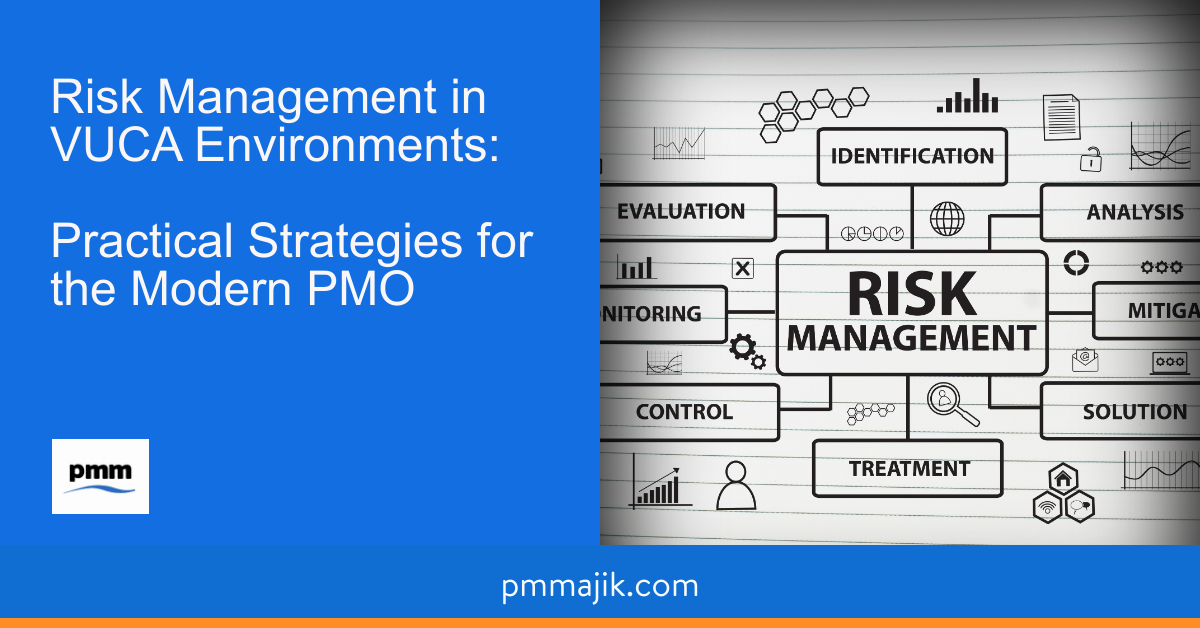
Unfortunately, conventional VUCA is not always enough when deploying the best risk management approach. To move beyond traditional risk registers, Project Management Offices (PMOs) as we know them today are expected to blend into a more proactive and dynamic approach to risk management.
This piece is expected to draft actionable and understandable strategies for handling risks in a VUCA world and explain why traditional risk approaches fail.
Understanding VUCA – What It Means for the PMO
There are some VUCA organizational principles on which the PMO must work to succeed. One of them is the fast-changing project requirements that mandate PMOs to adopt shifting project goals, budgets, and timelines. Another is the need to be proactive in identifying and preventing impending risks, as it has a way of always projecting itself.
As a PMO personnel in an organization practicing VUCA, there’s a need to create contingency plans to address nuclear project outcomes. However, there are some practical steps all PMOs need to observe to deal with this situation effectively. Below are some active steps to achieve a proactive approach for the PMO:
1. Risk Management Maturity Assessment
This is where a maturity assessment should be conducted to ascertain the recent identity areas and risk management practices that need improvement.
2. Risk Management Strategy
It is advised that organizations’ PMOs develop a risk management strategy that aligns with their parent goals and objectives. This strategy is expected to detail the organization’s risk management strategy, responsibilities, and roles.
3. Risk Identification and Assessment
This involves regular identification and assessment procedures, which also demand continuous risk review and regular updates, effective participation of stakeholder interaction and responses, evaluation of historical data, lessons learned, and the consideration of perceived external and internal factors.
In this case, volatility is the fast, unpredictable changes in the organization’s operations. Some known ones are political shifts, which can come from the political development of the operating environment. Another is a possible technological disruption, which usually occurs due to technological innovation or evolution (as the case may be).
The uncertainty part of the VUCA results from the absence of predictability, which is not always the best approach for the PMO. A relatable case is the deliberate change of stakeholder priorities, which is often seen as unsolicited.
Complexity is another part that VUCA PMOs must prioritize. This involves multiple interconnected choices that often present themselves. It is left for the organizations to weigh their options – choose between options that suit their present narrative. The final part is the ambiguity. This is used to describe situations that lack clarity or reasonable impacts. It is usually visible in cases where new technologies or methods emerge without a definite explanation for their operation. It is tagged ‘ambiguity’ until a clear path is defined.
Why Traditional Risk Approaches Fall Short
The reason for the underperformance (or, in most cases, complete collapse) of the traditional approach is linked to its failure to account for the challenges and the complex nature of the VUCA environment. Another reason for the shortfall is its failure to adapt to changing circumstances. This can be because the PMO staff are not fast enough to adapt, or the organization operates on policies that dwarf innovation, indirectly encourages primitively.
Conventional risk approaches usually depend on static risk assessments, which can easily phase away in a fast-changing environment. Also, the failure to blend into a changing situation can lead to inadequate risk mitigation. The oversimplification of complex systems is also one of the primary reasons for the failure of traditional risk approaches.
It oversimplifies complex relationships and fails to account for the interconnectedness of risks. This can lead to inaccurate risk assessments, which come with their consequences.
Conclusion
To survive in a VUCA environment, PMOs must reconsider and retool their risk approaches by adopting a strong risk management approach. Examples include iterative risk assessments, which regularly update risk assessments to influence the current scope of the changing project.
There’s also the adaptive risk mitigation, meant to create flexible and adjustable risk mitigation strategies, as demanded by the present condition. Finally, they should also consider adopting advanced data analytics. It uses data analytics to identify patterns, trends, and similarities that inform risk management decisions.